
In the winter of 1912, in a cold studio in Montmartre, a twenty-five-year-old Spaniard sat down to paint a portrait of his neighbour. The neighbour was Pablo Picasso, five years older, already famous, already the man who had invented the language the younger painter was working in. Juan Gris had been living in the same building, the Bateau-Lavoir, since 1906. He had watched Picasso and Braque dismantle the human figure into planes and shards. He had absorbed their method. And now, in this one canvas, he did something neither of them had done.
The painting is called Portrait of Picasso. It hangs today in the Art Institute of Chicago, oil on canvas, a little under a metre tall. It shows a face in profile, broken into facets, held together by a grid. If you have seen any cubist portrait from the period, you know the visual vocabulary. What makes this one different is what Gris did with the grid.
The Bateau-Lavoir and the Rivalry
Picasso and Gris knew each other well. Gris had arrived in Paris from Madrid at nineteen, worked as an illustrator for satirical papers, and only turned to painting after watching the older man's work. By 1912, Picasso was the recognised leader of the movement. Braque was his partner. Gris was, on the surface, a follower. Behind the scenes, he was already working out an argument with both of them.
Gris had one advantage they did not. Before he came to Paris, he had trained as a mathematician and an engineer. He thought in systems. Where Picasso and Braque treated cubism as a process of breaking a form apart, Gris treated it as a process of building one up from the pieces. His biographer Daniel-Henry Kahnweiler noted that Gris once told him, "Cézanne turned a bottle into a cylinder, but I make a bottle, a particular bottle, out of a cylinder." The sentence is short and it explains the entire difference between Gris and the two men he admired most.
 Gris painted Picasso in the winter of 1912. The canvas is under a metre tall and hangs today in the Art Institute of Chicago.
How the Portrait Is Built
Look at the head. It is turned in profile, facing left. The forehead is a wide plane, almost architectural. The nose is a triangle of grey-brown, sitting on the edge between two other planes. The eye is a dark shape, no iris, no highlight, a simple cut in the surface. None of this is a face in the traditional sense. All of it reads as one, because Gris holds the pieces in an invisible structure.
Follow the lines downward. The neck becomes a column, but the column is made of four separate strips of colour. The shoulders dissolve into the background, and the background is not a background — it is a shallow stage of overlapping rectangles. A wine glass sits on a table at the lower left. A book or a newspaper appears at the lower right. Gris did not paint these objects to decorate the portrait. He painted them to anchor it, the way a builder uses a plumb line.
The palette is narrow. Warm ochres, cool greys, dark umbers, and a few touches of near-black for the eye and the collar. There is no blue in the painting, no red, no green. Gris worked from a set of about six or seven pigments and built every form from combinations of those. The result is quiet. It does not shout the way a Braque or a Picasso of the same year might shout. It sits still.
The Layers Under the Surface
If you look at the canvas in raking light, the surface is not flat. Gris worked in thin oil, but he applied the paint in careful, deliberate passages, with visible edges where one plane meets another. There are no drips, no rapid gestures, no accidents. The paint is dense where the planes should read as close, and thinner where they should recede. In a few places, the canvas weave shows through, and the raw texture becomes part of the composition.
He was already starting to introduce collage elements in other works from the same period, small pieces of newspaper or wallpaper pasted onto the surface. In the Picasso portrait, he holds back. Everything is painted. The discipline is the point. Gris was proving that the fragmented language of cubism could carry a portrait without resorting to theatrical effect.
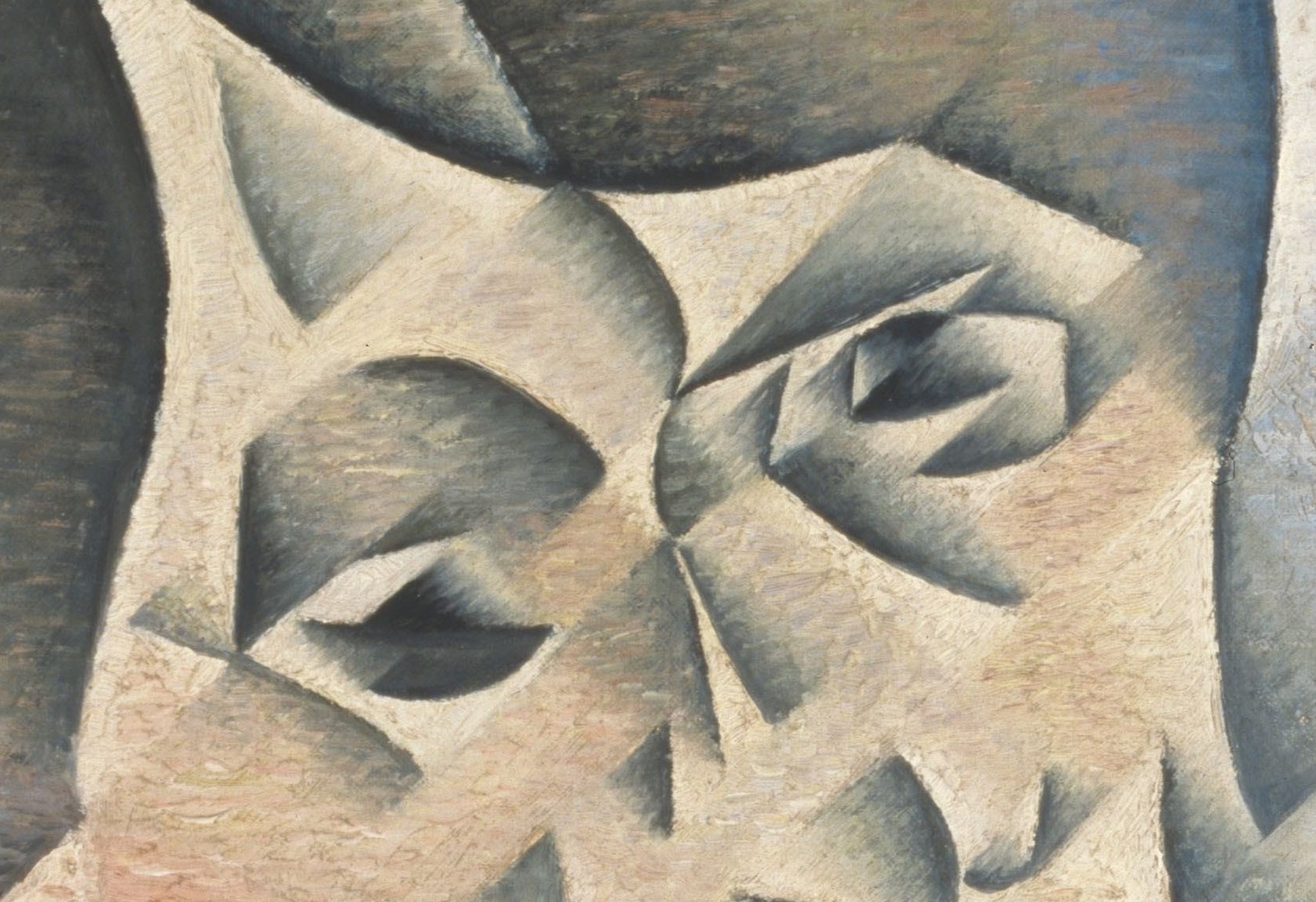 The face in profile is built from about a dozen planes. The eye is a cut in the surface, no iris, no highlight. It reads as a face because the structure holds.
Why a Print Flattens the Structure
The whole argument of this painting sits in the depth of the paint. Gris modulated the surface to place one plane in front of another, and the eye reads those small shifts as space. A digital print lays pigment in an even layer across the whole image. The planes collapse into a single flat pattern. The ochres and greys turn muddy. The face reads as a design, not as a head.
A hand-painted oil reproduction is built the same way Gris built the original. The ground first, then the broader planes in thin passes, then the details — the eye, the edge of the collar, the wine glass — set on last. The result is not a picture of the Picasso portrait. It is a surface that keeps the same small shifts of paint depth, and with them, the same quiet structure.
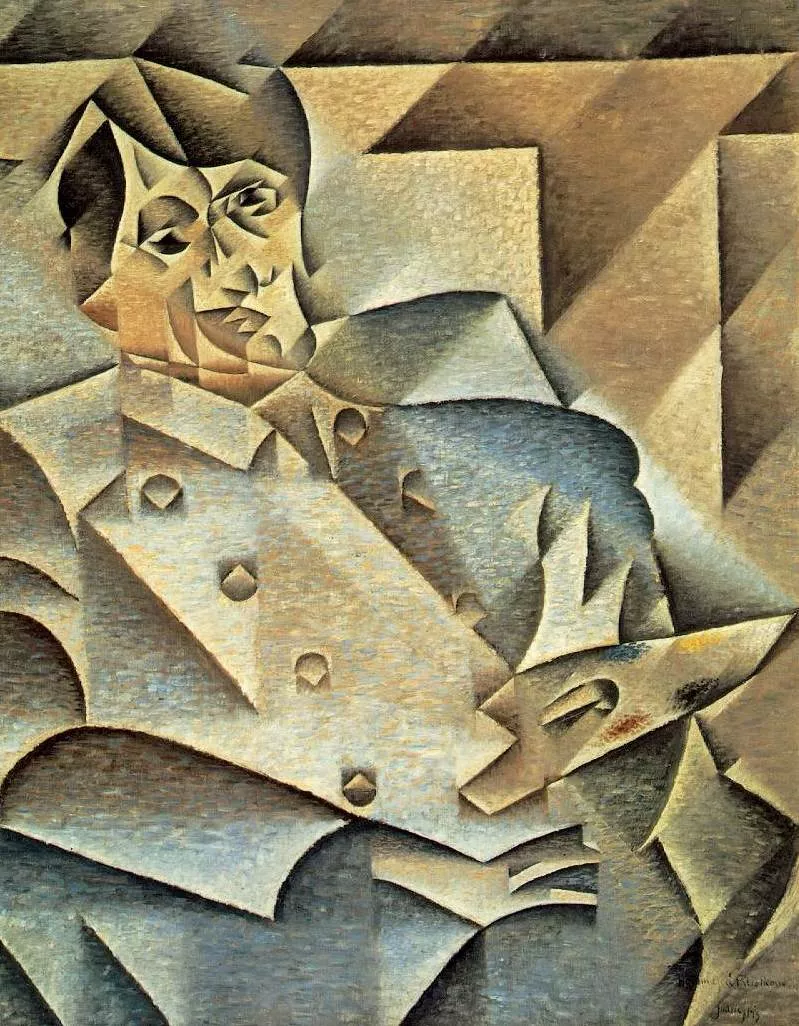 Gris built the portrait plane by plane in thin oil. A reproduction built in the same order keeps the depth that a flat print loses.
What to Look For
Start at the eye. Then move down to the collar. Then to the wine glass. Notice that the glass is not a glass — it is three curved shapes and a line. Notice that the collar is not a collar but a strip of near-black sitting on a strip of ochre. Notice that the whole face is held together by nothing you can point to directly, and yet it holds.
Gris kept this painting for years. He was twenty-five when he made it, and he had just started to find the argument he would spend the rest of his short career developing. He died in 1927 at forty. He never became as famous as Picasso. The portrait still sits in Chicago, in a room with other cubist works, and it is the quietest painting in the room.
See Portrait of Picasso as a hand-painted oil reproduction at oilpaintings.com. The planes are built in thin layers, the way Gris built them, in oil on canvas. View the painting
Images: Wikimedia Commons (public domain).